From the good folks at ReasonTV, hosted by Ted Balaker.

Monday, December 31, 2012

Sunday, December 30, 2012
Star Dreck; How the Federation Fails.

Set phasers on sanctimonious!
Every once in a while I like to poke fun at popular culture. The sphere of geekdom, of course, is a large part of popular culture and in turn, Star Trek is a large part of geekdom. No science fiction franchise is immune from comparison to the iconic Star Trek universe consisting of 5 live action television series, 1 animated series, 11 (soon to be 12) films, countless games, action figures, plastic hobby models, costumes and toy props. The fans themselves are so dedicated and prolific that they have inspired at least 2 documentaries and have continue to fill convention halls in cities across the world for decades.

Behold; the future.
By all accounts, Star Trek is just good clean fun and most of the fans simply love the fantasy and spectacle of the fictional universe. However I have noticed in recent years that many self-proclaimed Socialists, Communists and even the nutty "Zeitgeist" movement advocates, hereafter referred to as "techno-leftists" (I don't know if that's a real term, but damn it, I'm using it anyway), point toward Star Trek and specifically, the Federation as their model civilization. To my mind, there is no more sense in choosing a fictional universe meant for entertainment as a model society as there is in choosing the board game Monopoly as a model for real estate investment. Nevertheless, the point has been brought up enough times to provoke a response, if only done for fun. Warning; The following is lengthy and is littered with references and jargon that relate to the Star Trek franchise. Anyone unfamiliar with Star Trek will find the following very confusing. Geeks read on.
Allow me to say that for the most part, I like Star Trek. I like the swashbuckling of the original Star Trek series, the camaraderie of the Next Generation, the politics of Deep Space 9, the sense of a long journey home of Voyager and even the clunky, analog feel of Enterprise. Like any good fantasy, Star Trek makes it easy for viewers to see themselves in the adventures themselves, fighting (and loving) alongside their favorite characters. In effect, the fans felt as though they were along for the ride as a silent, but present, crew members. Indeed, I remember as a kid there was a promotion on a cereal box in which contest entrants could win a cameo appearance on Star Trek the Next Generation. The promotion showed characters Riker and Troi on either side of a human figure cutout with the words "This could be YOU!" How exciting! As a kid I wanted Star Trek to be real. And why not? A universe free from poverty, sickness, war or racism, free access to Holodecks and food replicators...sign me up! Hell, maybe Star Trek was real and the "show" was just a way to gently acquaint people, such as myself, to the real world.
In retrospect, my belief in Star Trek was like my belief in Santa Claus; deep down I knew it wasn't real, but it was still pleasant to pretend, at least for a while. Alas, I grew up and eventually came to realize what a terrible place the Star Trek universe is.
To be fair, many of the show's inconsistencies and contradictions are the result of different writers working at different times, and while writers typically follow a writer's "bible", they might not follow what other writers had written before them. Also, budget and time constraints are always a factor, so the writers, actors and even production designers are forced to cut corners in order to tell a story in a practical way. However, if one is going to use Star Trek as a model for society, at least some of these inconsistencies must be addressed. (We can safely ignore unimportant issues like that of Data's Cat, who, throughout the series not only changes breed, but also gender.)
But before we identify what is wrong with Star Trek, let us examine what techno-leftists find so appealing. As one self-identified Communist (to whom I will not give credit as he will likely spam me or someone I love to death, but if you really want to know, lookup "examples of communism in star trek" on youtube and find the comments most commonly flagged for spam and you will see what I am talking about) quotes, ad nauseum, counselor Troi from Star Trek; First Contact.
"[Proof of intelligent, extraterrestrial life] unites Humanity in a way no one ever thought possible when they realize they're not alone in the universe. Poverty, disease, war -- they'll all be gone within the next fifty years." (emphasis mine)Troi makes this prophecy to Zefram Cochrane when the crew was in the "past" of 2061. The plot is too complex to explain here, but since Troi is from the future, she believes the statement to be true.
Captain Picard too makes several comments that appeal to the techno-leftists. For example, in the TNG episode "The Neutral Zone", the Enterprise recovers 3 frozen people from the late 20th century. One of whom expresses his deep concern over his stock portfolio and is shaken to learn that not only does the Stock Market no longer exist in the 24th Century, but, as Captain Picard tells it;
"A lot has changed in the past three hundred years. People are no longer obsessed with the accumulation of things. We've eliminated hunger, want, the need for possessions. We've grown out of our infancy."In First Contact, when asked how much the Enterprise cost to build Picard says;
"The economics of the future is somewhat different. You see, money doesn't exist in the 24th century... The acquisition of wealth is no longer the driving force in our lives. We work to better ourselves and the rest of Humanity."
The series creator, Gene Roddenberry also contributed to the sense of a moneyless, one-world government. Writer Ronald D. Moore recalls;
"By the time I joined TNG, Gene [Roddenberry] had decreed that money most emphatically did NOT exist in the Federation, nor did 'credits' and that was that. Personally, I've always felt this was a bunch of hooey, but it was one of the rules and that's that."A line from Voyager Episode Dark Frontier exemplifies this point. Tom Paris explains;
"When the New World Economy took shape in the late 22nd century and money went the way of the dinosaur, Fort Knox was turned into a museum."
Lastly, the idea of a post-scarcity world appeals to the techno-leftists because, after all, why toil doing boring or dangerous work if one has access to literally any good for free?
From the Series, Films and supporting material, we can gather a small, but by no means exhaustive, list of what appeals most to techno-leftists.
- Monolithic Government with (apparently) no political parties
- High reliance on technology
- No money
- No poverty
- No war
- No racism
- No disease
Monolithic Government; True. The United Federation of Planets is a highly centralized military dictatorship with Starfleet as it's sword. The Federation clearly controls everything; communication, commerce (what little is left) and even food distribution. There is no Coke, no Pepsi, no Snapple, nothing but what the Federation supplied replicators will issue with the consensus being that replicated food and drink are inferior to the genuine articles.
Politically, the Federation is a mess. It seems mostly Starfleet officials make the lion's share of decisions but sprinkled in a few of the original cast films is the Federation President who openly negotiates with foreign powers and even claims that "This President is not above the law."

Don't like how I run things? Then please address all
complaints to the office of go fuck yourself.
But by the time of TNG there isn't a peep out of the executive's office. The President's office does however come up again in DS9, when the Federation is at war with the Dominion. From Memory Alpha's page on the DS9 episode Homefront;
Sisko has a number of recommendations for the President regarding the Dominion infiltration and how it can be combated. The President is not eager to turn Earth into a military outpost where everybody must submit to blood tests and phaser examinations of every room must be carried out. He quickly changes his mind however when it turns out that the attaché case Sisko was carrying is, in fact, Odo. Odo points out that Sisko and Leyton were allowed to see the President without having to undergo a blood test or having their personal property checked. If he had been a Founder, he could have killed the President or simply taken his place. The President begrudgingly agrees to allow the new security procedures saying that it has taken a lot of hard work to change Earth into the peaceful place that it now is and that he doesn't wish for this paradise to be destroyed. "We're not looking to destroy paradise," says Sisko, "we're looking to save it."So, on a whim, the President can turn Earth into a series of checkpoints and blood tests. Sisko might call that the preservation of paradise, I would call it the gestapo. One might argue that it is only Federation facilities that are subject to the increased security measures, but since the Federation clearly control most of the the means of travel, the planet is effectively put on lock-down. Is there any sort of legislative or judicial oversight? Is there even the ability to protest? Apparently not. If Earth has it's own government then it was overridden by the Federation President. Whatever the Federation nomenklatura say, goes. As for the claim of "Paradise", well Micheal Eddington sets that record straight.
You tell 'em Mike.
High reliance on technology; True, but with dire consequences. Between transporter accidents, coolant leaks in the reactor and Holodeck malfunctions, it is clear that no one knows how anything works on a Federation ship. In the TNG episode "Evolution", microscopic robots called Nanites take over and almost destroy the Enterprise. Why? Because a teenager left a petri dish open. That's right, a high schooler's science project escaped and almost destroyed the most advanced ship in the Federation. In TNG episode "Where Silence has Lease", the USS Yamato (the Enterprise's sister ship) is destroyed by downloading alien computer data that couldn't be processed correctly. The same fate almost befell the Enterprise until the crew made the last ditch decision to reboot the ship. This means that no one aboard the Yamato was smart enough to hit the off and on buttons on the ship before it was too late. The sister ships Yamato and Enterprise simply lack something as simple as a honeypot to quarantine and test questionable alien data. After the crisis, the crew of the Enterprise are pleased to learn that is was not, in fact, a design flaw in Galaxy-Class starships that caused the Yamato disaster as originally suspected. I'd say not isolating your critical systems from harm is a pretty damned serious design flaw.
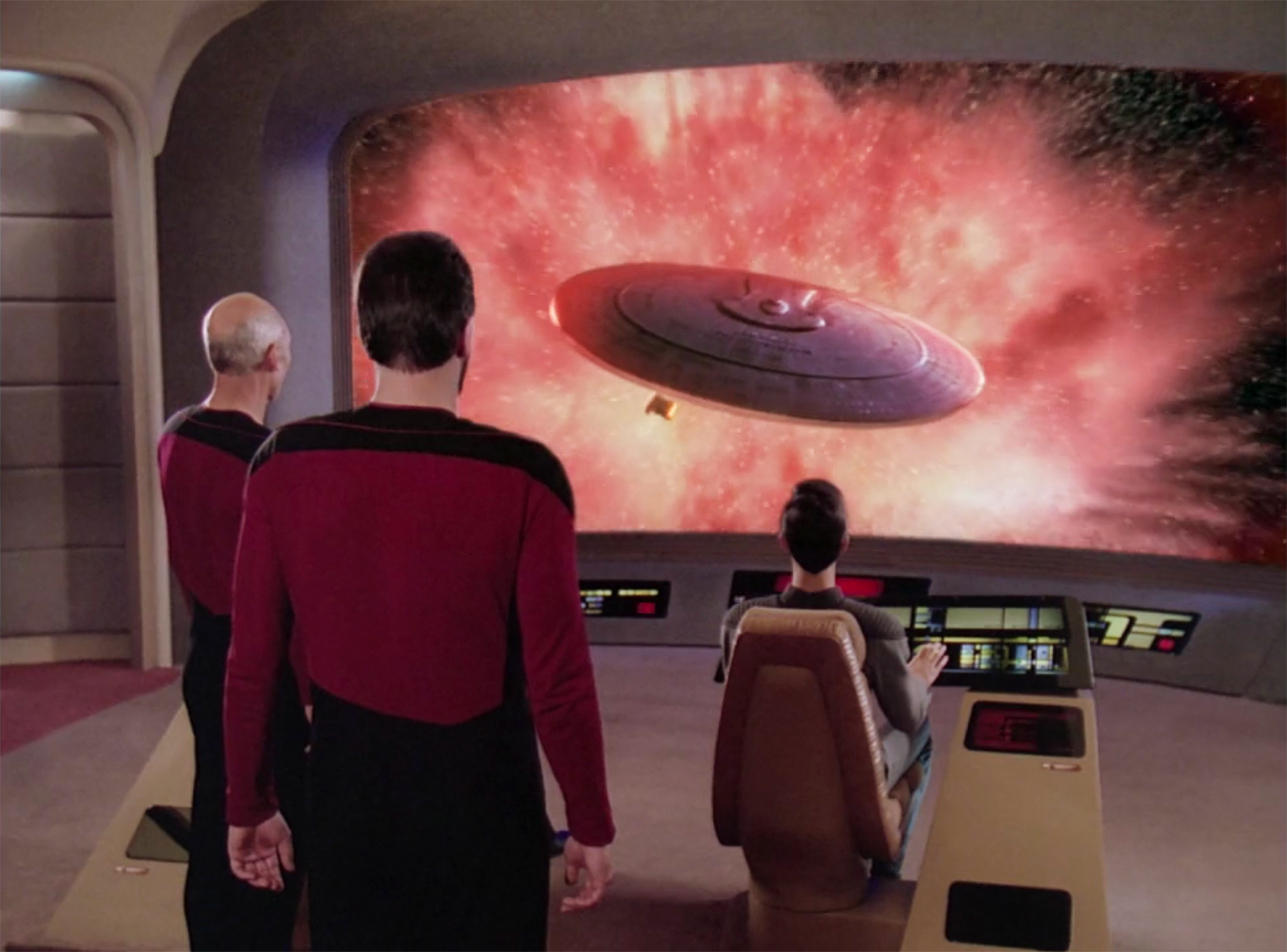
Whoopsie daisy! I guess someone forgot to install the firewall.
The Holodeck too malfunctions in multiple episodes, again, threatening various crew members, but also leading to the problem of "holo-addiction" with crew members becoming obsessed with simulations. Evidently zipping around the universe, discovering new life and civilizations is so boring that some prefer holograms to reality. Whatever the case, it is clear nobody understands how the contraptions are made. Riker and Data think that most of what is in the Holodeck is real; replicated plants, rocks, water etc. While Picard explains that a Holodeck simulation is merely a collection of photons and force-fields. Yet everyone is caught off guard when the "simulated" Professor Moriarty becomes self-aware. As for the engineering of the Federation, one only needs to look towards the unfortunate Geordi LaForge. Why he is repeatedly put in harm's way on missions unrelated to engineering seems to me as a serious misallocation of resources, but even when he is where he is supposed to be, the poor fellow seems to attract nothing but disaster. Is he really the best engineer in Starfleet? Or is Starfleet just that poorly engineered?
Please, for his sake and yours, don't let Geordi near
any consoles, or turbolifts, or phasers, or rocks, or people.
No Money; Claimed but demonstrably false. This is one of the more confused and contradictory topics in the Star Trek Universe. Several episodes in multiple series and films make reference to "payments", "prices", "credit" to an "account" and so on. It can therefore be assumed that the Federation has some kind of monetary system, but the details are never explained because, well, it's science fiction. It is clear however that the Ferengi not only use money, but this is one of their more distasteful qualities. So far as the Star Trek Universe is concerned, the only good Ferengi is one that is disinterested in money, which is established to be extremely rare. Whenever the topic of economics is brought up, it is always with a sense of smugness on the part of the Federation and anyone who pursues profit is seen as being medieval, irrationally self-absorbed and rude. The Ferengi who exemplify Capitalists, (In the mind of Roddenberry and some of the writers) are cartoony charactures whose only concern is the pursuit of profit. If the Federation, and for that matter, Gene Roddenberry took the time to stop looking down their noses at money and those who use it, they might discover what money is; a medium of exchange. In other words, it is a lubricant for creating agreements and investing in new ventures. To be against money is to be against mutually beneficial exchange.
Ultimately Roddenberry's vision for the future, particularly in TNG onward was that people only worked because they wanted to, not because they had to. But, what if someone likes to earn money? What if someone likes to acquire things that cannot be replicated such as original works of art or ancient artifacts. Such people do exist in Star Trek, and not all of them are villains. One of the most notable is Captain Jean Luc Picard who is an avid collector of archaeological relics. So when he says that humanity is no longer "obsessed" with the accumulation of things, take it with a grain of salt. Of course Picard, when berating a 20th century Capitalist, ignores that the "accumulation of things" is a form of self improvement. Why should the pursuit of wealth, based on mutually beneficial trade be any different than the pursuit of physical fitness, sexual prowess or mental deftness? What's the harm? The Federation apparently assumes the zero-sum fallacy with regards to economics. Evidently, Adam Smith's works didn't survive to the time of Star Trek.

Where's that employee discount you promised me, you cheap bastard!
No Poverty; False. This is an interesting claim because although Earth doesn't appear to have any problems with poverty, it is clear that many of the Federation's colonies do. Yet even on Earth, the Capital of the Federation, Picard's own brother and nephew were killed in a fire (Generations). Perhaps Picard's brother, Robert, eschewed technology that would suppress a fire (like water), but on the other hand, the ships of the Federation have their fire-suppression systems fail very often. So how "rich" can the average person be if even the flagship of Starfleet can't put out a measly fire. As for the Federation's colonies, they vary greatly in living standards. Tasha Yar's planet, Turkana IV, was a failed colony that essentially destroyed itself with civil war and rampant drug abuse. Nimbus III, the so-called "Planet of Galactic Peace" is a barren wasteland inhabited by the dregs of the Federation, Klingon and Romulan empires. The capital of Nimbus III is ironically called "Paradise City", given that it is populated almost entirely of criminals and the pathetically stricken. Federation Ambassador St. John Talbot refers to the planet as the "armpit of the galaxy" and it is clear that Nimbus III is used as a place to exile those Ambassadors who have fallen out of political favor within their own government structures. Nimbus III is a failure of central planning by no less than three galactic powers, with the Federation unable or unwilling to correct the problem.
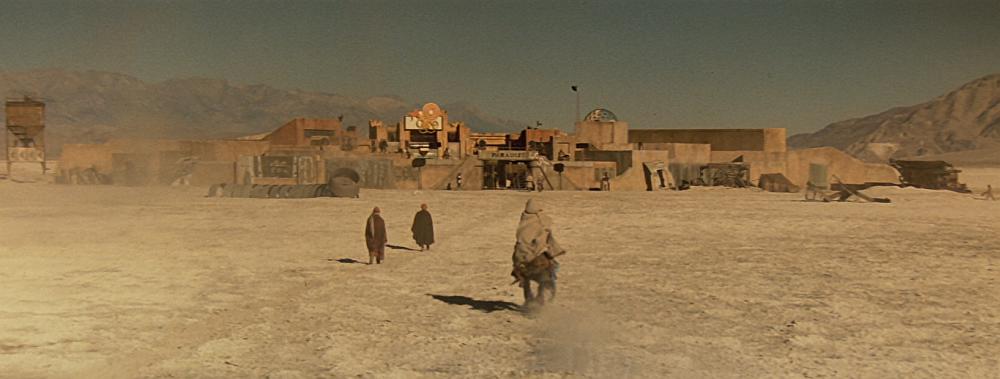
Take me down to the Paradise City
Where the people are poor and the sand is gritty.
Where the people are poor and the sand is gritty.
Even if we accept the statement that poverty has indeed been eliminated on Earth, this is like saying poverty has been eliminated in the richest parts of Beverly Hills, given the size of the Federation relative to the size of the Earth. How dishonest must the Federation officers be to insist that poverty has been "eliminated" when they are only referring to a comparatively tiny minority of the Federation? After all, if no one "wants" on Earth, why can't the benevolent Federation make all member planets just as pleasant?
No War; False. If it is meant that there is no intraplanetary war on Earth, this might be acceptable, but, like the poverty claim, this would be a dishonest statement by reason of willfully omission. War means war, either from without or from within and it is clear that Earth itself, not just the fringes of the Federation, has been a participant in many wars and at least a handful of direct attacks against Earth itself. The Borg actually succeeded in assimilating the Earth, but the Earth was saved by that Sci-Fi deus ex machina; time travel. In the 200 or so years between Enterprise and Voyager, the Federation and Earth with it have been at war with the Romulans, Klingons, Gorn, Borg, Dominion and others. While the Earth itself was not necessarily touched in all of these conflicts, again, given the size of the Federation this is no more accurate than saying the United States was at peace during WWII because Washington D.C. was never directly attacked.

Off we go to spread peace, with our peace-phasers and peace-torpedoes.
But lets face it; a Space Opera would be pretty boring without a war, so there was plenty of conflict in Star Trek. This put the writers in a bind; no war means no viewers, but war means the Federation aint so good at the peace game. The compromise was that the Federation could never be the aggressor, always the defender. The last to enter war, the first to broker peace. Sounds great! But, as the war with the Maquis demonstrates, it is also false. Without getting into too much detail for this already too-long post, the Maquis formed when the Federation and Cardassian empire redrew the map and several inhabited planets were ceded over to Cardassian control, but it was made clear that the Cardassians never intended to peacefully let the settlers stay on the planets in question and a campaign of harassment began, so the Maquis was created as a means to combat the Cardassian abuses. The Federation, feigning desire to "keep the peace" branded the Maquis as terrorists and began going after them. But herein lies the rub; the peace had already been shattered when the Cardassians began harming the lives and property of the colonists. Whatever treaty was supposed to exist between the two powers was rendered null and void as soon as hostilities began. The Federation wasn't interested in peace, but appeasement to a hostile force that had a proven track record of war and genocide. There are other examples of Federation aggression, either officially sanctioned or conducted by rogue leaders, such as Admiral Cartwright and the Khitomer conspiracy, Admiral Mark Jameson and the Mordan IV civil war and forcible removal of the Ba'ku from the planet of the same name.* So either the Federation is criminally incompetent, or just criminal. Either way, the Federation is not peaceful.
*Okay, so the Ba'ku are holier-than-thou assholes and the events surrounding them are morally murky at best, but it is hard to justify their removal when alternatives appeared to exist. For a hilarious and insightful video review of Star Trek; Insurrection, go here.
No Racism; False. For all their talk of being an enlightened, multi-ethnic, tapestry of culture, the Federation spends a lot of time in judgement of other races and cultures. Worse than that, the Federation pigeon-holes entire civilizations for the actions of a few. For example, commander Kira Nerys makes her feelings known about the Ferengi;
"They're greedy, misogynistic, untrustworthy little trolls, and I wouldn't turn my back on one of them for a second."

Kira Nerys; Starfleet Commander, Bajoran Colonel, Racist.
The self-loathing of Torres aside, an objective analysis of Star Trek reveals that, sadly, racism is alive and well in the 23rd and 24th centuries, but interestingly enough, this topic was addressed several times, even in the original series. I give the writers credit for at least acknowledging that within the Federation, some pretty blatant racial bigotry existed, but on the other hand, most other races are depicted as monolithic cultures with very little variance among the people. The odd exception to the rule is just that; odd.
No Disease; False. This is the easiest claim to refute by the shear number of episodes which concerned illnesses of one sort or another. Captain Picard, in an alternate future and in at least one book, is diagnosed with "Irumodic Syndrome". This is the guy who has access to the best doctors in the Galaxy. If that were not enough, Picard almost dies on the operating table when his artificial heart was being replaced because of the surgeon's incompetence. In a universe as advanced as the Star Trek universe is, I would expect 2 things; that artificial hearts last a lifetime, and that surgeons know what they are doing. According to the show, this is asking too much. Suffice to say, if the Captain of the flagship gets lousy care, what hope is there for the rest of the Federation? For that matter, Admiral Mark Jameson contracts the incurable Iverson's Disease. Other diseases include Clarkes Disease, Sharat Syndrome, Darnay's Disease and Rushton Infection, to name a few.

It's the big one Elizabeth! I'm comin' to join you!
Conclusion; Living under the Federation boot would be unpleasant to say the least. Sure, one is free to self-improve, so long as it is the self-improvement the Federation approves of. The sacred "Prime Directive" which is held so dear turns out to be quite flexible, particularly when its violation provides a benefit to the Federation. If there is no benefit, well, the Federation is quite happy letting other civilizations go extinct even if by no fault of their own. True, no society lives up to the hype, but the Federation doesn't even work on paper without violating the various laws and directives that are supposed to make it so special. Ultimately, Star Trek just an entertainment franchise and should be enjoyed in much the same way potato chips are enjoyed; pleasant junk. It shouldn't be taken seriously and neither should anyone who believes the Federation to be an ideal society.

Jesus, the future sucks. Let's drown our sorrows
in these tankards of Romulan ale.
Special thanks to all those geeks out there maintaining great sites like Memory Alpha, SF Debris and Wikipedia. Live long and prosper.
Friday, December 21, 2012
Gun Rights Versus Security
In light of the Sandy Hook Connecticut massacre and the monster Adam Lanza, I think it is appropriate to address the gun issue, albeit a few days after the tragedy to allow tempers to cool and for more facts to come in. I know my opinions will be of no comfort to anyone affected by these terrible crimes, but hopefully it will help expand the important dialog.
Let it first be said that reasonable people can disagree on gun control and, in general, people have the best of intentions, but differ on the means.
As far as numbers, it is important to point out that, although such mass murders are truly sickening, murders overall have been on the decline since the 1990s. This is despite a greater population and a greater number of guns. Assuming the source is correct, there is a gun for just about every man, woman and child in the United States, yet there are not 310 million murders or accidents.
This presents a paradox which is not easily understood or explained. On the one hand we have more people, more guns and less crime, yet mass killings seem to occur with alarming frequency.
Another thing to consider is the worst acts of murder committed in the U.S. were not committed with firearms at all. For example;
Even in societies which are known for being socially and economically stable have witnessed horrible mass killings, such as in Norway and Japan. Of course none of this is of any comfort to the families of the victims of any murder, despite the means and it is shocking to know that if someone really wants to murder, he will find the means.
So what do we do about it? Even if we assumed that there was no second amendment and guns could be banned tomorrow, would it work? We know from the prohibition of alcohol and drugs that black markets spring up all over the place. What practical means is there to remove 310 million firearms anyway?
On the other hand, we know that armed people do indeed defend themselves and others from mass killers and rioters. For example, there was Vice Principal Joel Myrick who stopped killer Luke Woodham with his .45. There was Jeanne Assam, a volunteer security guard at New Life Church in Colorado Springs who cut down spree killer Mathew Murray, which more than likely prevented many more deaths. And there are the Korean store owners during the 1992 L.A. riots who defended their lives and property.
Are these the exceptions to the rule? I'm not sure anyone can say because it is extremely difficult to report on murders that didn't happen because one of the good guys had a gun. However I don't think that the killings in Newtown/Sandy Hook Connecticut , Aurora, Colorado and so on occurring in so-called "gun-free zones" is a coincidence. After all, if the goal is to kill as many as possible, one looks for the most defenseless. In the case of Adam Lanza, he killed his mother at home then went to the school. If the reports are accurate, Lanza killed himself when the police arrived. In other words, he only stopped killing when others came to challenge him. A similar pattern existed for Virginia Tech killer, Seung-Hui Cho.
Considering these factors, I believe it makes sense for there to be armed personnel at public schools and to remove the imposed "gun-free zones". This seems shocking at first, and it might not prevent future violence, but it does give innocent people a fair chance, and while the killer is occupied with well-trained defenders, it gives more time for others to escape. This is not a perfect solution. There is no perfect solution, particularly when mental illness is not well understood. But, this is not an impractical solution either, and not as strange as one might first believe. For instance, when I was in 5th grade, my classmates and I were given D.A.R.E. training over the course of a few weeks, which included regular visits by a uniformed police officer. As she was on duty, she was armed. The notion went from shocking to routine in a matter of hours, and you had better believe that we were a well behaved class at those times. I believe there is no shortage of organizations who will provide very effective safety and accuracy training to school personnel.
The other side of the equation is much harder, and that is prevention. Preventing not only "crazies" from getting guns, but also from getting knives, cars and explosives. This means we all have to do our part to keep our guns and other potential weapons secure, and (this is the hard part) we must address the issue of those who are mentally disturbed. For I believe the root cause is the disturbed man's desire to kill, and not the means he chooses to do it. But I do not believe that disarming innocent people will prevent any future tragedies.
Suzanna Hupp's testimony illuminates the subject rather succinctly.
Murder in any capacity is a terrible thing. Perhaps the most terrible thing we humans know. But we still must be practical, and we still want to be free. I firmly believe that the reason that the U.S. has not had a Stalin or Hitler or Mao or faced an invasion since 1814 is because of our 2nd Amendment. Murderous psychotics have taken so much from us, it would be a mistake to allow them to take away our freedoms and right to self-defense as well.
Edit; Here is an extremely interesting opinion that I read for the firs time today and it has been making its rounds on the web. I believe it explains the case for armed teachers better than I, and brings up a point I neglected to mention; it should be voluntary. Read it for yourself here and see what you think.
Let it first be said that reasonable people can disagree on gun control and, in general, people have the best of intentions, but differ on the means.
As far as numbers, it is important to point out that, although such mass murders are truly sickening, murders overall have been on the decline since the 1990s. This is despite a greater population and a greater number of guns. Assuming the source is correct, there is a gun for just about every man, woman and child in the United States, yet there are not 310 million murders or accidents.
This presents a paradox which is not easily understood or explained. On the one hand we have more people, more guns and less crime, yet mass killings seem to occur with alarming frequency.
Another thing to consider is the worst acts of murder committed in the U.S. were not committed with firearms at all. For example;
- September 11th attacks used planes hijacked with box cutters, killing nearly 3,000.
- Oklahoma City Federal Building was attacked with a truckload of explosives made from fertilizer, killing 168.
- Serial Killer Gary Ridgway killed at least 71 victims by strangulation. Ted Bundy and John Wayne Gacy used similar M.O.s
- The worst attack on a school was conducted using explosives, killing 45 (including the bomber) in 1927.
Even in societies which are known for being socially and economically stable have witnessed horrible mass killings, such as in Norway and Japan. Of course none of this is of any comfort to the families of the victims of any murder, despite the means and it is shocking to know that if someone really wants to murder, he will find the means.
So what do we do about it? Even if we assumed that there was no second amendment and guns could be banned tomorrow, would it work? We know from the prohibition of alcohol and drugs that black markets spring up all over the place. What practical means is there to remove 310 million firearms anyway?
On the other hand, we know that armed people do indeed defend themselves and others from mass killers and rioters. For example, there was Vice Principal Joel Myrick who stopped killer Luke Woodham with his .45. There was Jeanne Assam, a volunteer security guard at New Life Church in Colorado Springs who cut down spree killer Mathew Murray, which more than likely prevented many more deaths. And there are the Korean store owners during the 1992 L.A. riots who defended their lives and property.
Are these the exceptions to the rule? I'm not sure anyone can say because it is extremely difficult to report on murders that didn't happen because one of the good guys had a gun. However I don't think that the killings in Newtown/Sandy Hook Connecticut , Aurora, Colorado and so on occurring in so-called "gun-free zones" is a coincidence. After all, if the goal is to kill as many as possible, one looks for the most defenseless. In the case of Adam Lanza, he killed his mother at home then went to the school. If the reports are accurate, Lanza killed himself when the police arrived. In other words, he only stopped killing when others came to challenge him. A similar pattern existed for Virginia Tech killer, Seung-Hui Cho.
Considering these factors, I believe it makes sense for there to be armed personnel at public schools and to remove the imposed "gun-free zones". This seems shocking at first, and it might not prevent future violence, but it does give innocent people a fair chance, and while the killer is occupied with well-trained defenders, it gives more time for others to escape. This is not a perfect solution. There is no perfect solution, particularly when mental illness is not well understood. But, this is not an impractical solution either, and not as strange as one might first believe. For instance, when I was in 5th grade, my classmates and I were given D.A.R.E. training over the course of a few weeks, which included regular visits by a uniformed police officer. As she was on duty, she was armed. The notion went from shocking to routine in a matter of hours, and you had better believe that we were a well behaved class at those times. I believe there is no shortage of organizations who will provide very effective safety and accuracy training to school personnel.
The other side of the equation is much harder, and that is prevention. Preventing not only "crazies" from getting guns, but also from getting knives, cars and explosives. This means we all have to do our part to keep our guns and other potential weapons secure, and (this is the hard part) we must address the issue of those who are mentally disturbed. For I believe the root cause is the disturbed man's desire to kill, and not the means he chooses to do it. But I do not believe that disarming innocent people will prevent any future tragedies.
Suzanna Hupp's testimony illuminates the subject rather succinctly.
Murder in any capacity is a terrible thing. Perhaps the most terrible thing we humans know. But we still must be practical, and we still want to be free. I firmly believe that the reason that the U.S. has not had a Stalin or Hitler or Mao or faced an invasion since 1814 is because of our 2nd Amendment. Murderous psychotics have taken so much from us, it would be a mistake to allow them to take away our freedoms and right to self-defense as well.
Edit; Here is an extremely interesting opinion that I read for the firs time today and it has been making its rounds on the web. I believe it explains the case for armed teachers better than I, and brings up a point I neglected to mention; it should be voluntary. Read it for yourself here and see what you think.
Thursday, December 20, 2012
That Which I Am Certain Will Cost Me Friends.
Here are a few pictures which I made and I had completely forgotten about. Some are a little dated, but here they are all the same. As I have said before, I should have started this blog long ago so i could have made some posters for Bush in the same spirit.


That's the Constitution he's standing on by the way.
Tuesday, December 18, 2012
10 Pet Peeves I Encounter Online Almost Daily
- Using "ur" instead of "you are".
- Using "your" instead of "you're".
- Confusing there, their and they're.
- Confusing too, two and to.
- Using double negatives such as "We couldn't do nothing with the machine."
- Using non-words like "dat" or "dis" instead of "that" to "this".
- Using "could of" or "would of" instead of "could have" or "would have".
- Using "wat" and "wit" instead of "what" and "with".
- Using "prolly" instead of "probably"
- Using the word "literally" when "figuratively" is meant.
Monday, December 17, 2012
TL;DR
There are ways to offer criticism and there are ways to look like an idiot. Too long, didn't read is the latter. Can there be anything more juvenile, disrespectful or unintelligent?
In case this is your first time on the internet, posts, articles and that are considered by some to be too lengthy will earn the appallingly stupid TL;DR. Yes, some posts are long, but that has no bearing on whether or not the content is relevant, entertaining or true . TL;DR is perhaps the ultimate in intellectual laziness, for it dismisses a post or article without actually reading it.
Imagine a person who stands in a movie theater lobby and, when a crowd enters or exits a particularly long film, say Casino or Amadeus*, this person announces to everyone "That film was too long, I didn't watch!" Or this same person who stands by the cash register at a book store and tells the customers who have just made a purchase, "That book is too long, I didn't read it."
Apart from being extremely annoying, this person is the equivalent of the poster who responds to a written piece with "TD;DR". Logic would suggest that, unless asked directly, a person who found an entry to be too lengthy, they would silently skip it and go onto something else. However, the temptation to say something, no matter how inane, proves too strong for some. So what can someone say, when they have nothing substantive to contribute? Apparently, all they can muster is TL;DR. This is somewhat reminiscent of people who post "first" on message boards, presumably when no other comments have yet been made. It is childish, meaningless and annoying.
Sometimes, of course, it is perfectly valid to point out that something is too long, but this can only be known if the actual written piece in question were read. How else could someone know if it was too long, too short or just right unless one knows what is written? Saying something is too long implies that it was actually read, so the later half of "TL;DR" invalidates the former and thus exposes whoever wrote it as an idiot who pathetically tries to simultaneously denigrate a work they have not read while drawing attention to themselves. The only alternative is that the fool who responds with TL;DR has actually read the piece but cannot think of any valid critiques, so they resort to the written equivalent of plugging their ears, shutting their eyes and shouting "La la la la".
But we can't all be mature, high minded intellectuals all the time, can we? In the spirit of both brevity and immaturity, I submit the following response to anyone inept and foolish enough to use TL;DR
*Unlike many others, I don't regard Amadeus to be very long at all, perhaps because I hold it to be one of the best films ever made. Everyone is entitled to their own opinion.
In case this is your first time on the internet, posts, articles and that are considered by some to be too lengthy will earn the appallingly stupid TL;DR. Yes, some posts are long, but that has no bearing on whether or not the content is relevant, entertaining or true . TL;DR is perhaps the ultimate in intellectual laziness, for it dismisses a post or article without actually reading it.
Imagine a person who stands in a movie theater lobby and, when a crowd enters or exits a particularly long film, say Casino or Amadeus*, this person announces to everyone "That film was too long, I didn't watch!" Or this same person who stands by the cash register at a book store and tells the customers who have just made a purchase, "That book is too long, I didn't read it."
Apart from being extremely annoying, this person is the equivalent of the poster who responds to a written piece with "TD;DR". Logic would suggest that, unless asked directly, a person who found an entry to be too lengthy, they would silently skip it and go onto something else. However, the temptation to say something, no matter how inane, proves too strong for some. So what can someone say, when they have nothing substantive to contribute? Apparently, all they can muster is TL;DR. This is somewhat reminiscent of people who post "first" on message boards, presumably when no other comments have yet been made. It is childish, meaningless and annoying.
Sometimes, of course, it is perfectly valid to point out that something is too long, but this can only be known if the actual written piece in question were read. How else could someone know if it was too long, too short or just right unless one knows what is written? Saying something is too long implies that it was actually read, so the later half of "TL;DR" invalidates the former and thus exposes whoever wrote it as an idiot who pathetically tries to simultaneously denigrate a work they have not read while drawing attention to themselves. The only alternative is that the fool who responds with TL;DR has actually read the piece but cannot think of any valid critiques, so they resort to the written equivalent of plugging their ears, shutting their eyes and shouting "La la la la".
But we can't all be mature, high minded intellectuals all the time, can we? In the spirit of both brevity and immaturity, I submit the following response to anyone inept and foolish enough to use TL;DR
*Unlike many others, I don't regard Amadeus to be very long at all, perhaps because I hold it to be one of the best films ever made. Everyone is entitled to their own opinion.
Friday, December 14, 2012
Israel and Property Rights
Israel is a hot-button issue that polarizes people almost instantly. There is no litmus test for the question of Israel, though people on the left are generally wary of Israel and the perceived injustice done to the Palestinian population. On the other hand, there are those on the extreme right who do not like Jews in general and are against Israel simply for the fact that it is essentially Jewish.
For the record, I believe Israel should exist, however this does not excuse many of the actions the Israeli government has taken over the years. I will also say that much of what is said about a Palestinian state is highly disingenuous. Jordan is roughly twice the size of Israel, and Syria is about twice the size of Jordan. Add the territory of the rest of the Arabian peninsula, Egypt, Lebanon and Iraq and you have a gigantic amount of land that could easily accommodate the Palestinian population if those nations cared for the Palestinians (as they claim) more than they hated Israel and the Jews.
I will address these issues and more at another time. For now, I want to share a very insightful video on Palestinian property rights and how they pertain to Israel.
Yaron Brook is the president and executive director of the Ayn Rand Institute. For more information, please visit here.
For the record, I believe Israel should exist, however this does not excuse many of the actions the Israeli government has taken over the years. I will also say that much of what is said about a Palestinian state is highly disingenuous. Jordan is roughly twice the size of Israel, and Syria is about twice the size of Jordan. Add the territory of the rest of the Arabian peninsula, Egypt, Lebanon and Iraq and you have a gigantic amount of land that could easily accommodate the Palestinian population if those nations cared for the Palestinians (as they claim) more than they hated Israel and the Jews.
I will address these issues and more at another time. For now, I want to share a very insightful video on Palestinian property rights and how they pertain to Israel.
Yaron Brook is the president and executive director of the Ayn Rand Institute. For more information, please visit here.
Subscribe to:
Posts (Atom)